

Quick answer: A wet filter cake almost always traces back to one of five things: the cycle was ended before filtrate flow dropped off, the final feed pressure was too low or ramped too fast, the slurry was poorly conditioned, the cloth is blinded or worn, or the cake is too thin for the chamber. Fix those first; then add membrane squeeze or a longer air blow-down if you need to go from the 60–70% moisture of a chamber press toward 45–55%.
Key figures at a glance
- Cake too wet usually traces to: short cycle, low final feed pressure, poor conditioning, blinded cloth, or thin cake
- Check in this order: cycle end-point → feed pressure ramp → conditioning → cloth condition → chamber fill
- Typical targets: 60–75% moisture chamber press on sludge; 45–60% with membrane squeeze
- Membrane squeeze and air blow-down each remove a further few percentage points
- Do not replace the press before fixing cloth, conditioning and pump settings
Filter press cake too wet is a dewatering symptom with four common causes explained below.
TL;DR: Wet filter cake usually comes from one of four causes: cloth micron rating too coarse for your solids, insufficient membrane squeeze pressure, feed pump pressure too low to build a stable cake, or cycle time cut short. Fixing cake moisture is almost always cheaper than buying a bigger press: correct cloth selection alone can cut cake moisture by 5-10 percentage points, and adding membrane squeeze typically removes another 5-8 points versus a chamber-only press on the same slurry.
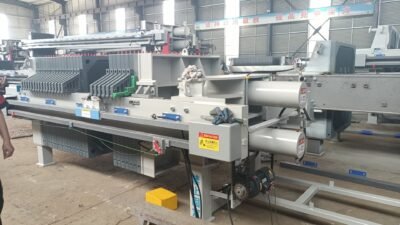
Filter Press Cake Too Wet? Here Is Why
The most common root cause is filter cloth that is too coarse for the particle size distribution of your slurry: coarse cloth lets fines bleed through instead of forming a tight, low-permeability cake, so filtrate keeps flowing through channels in the cake rather than being squeezed out evenly. The second most common cause is feed pump pressure that is too low in the early stage of the cycle, which prevents a dense cake from forming in the first place. Both issues compound: a loose cake filtered under low pressure stays wet no matter how long you run the cycle.
Does membrane squeeze pressure actually matter for cake dryness?
If your filter press cake too wet even after cloth checks, membrane squeeze pressure is usually next. Yes, substantially. A membrane (diaphragm) press applies secondary mechanical pressure to the formed cake after initial filtration, physically compressing out moisture that gravity and filtration pressure alone cannot remove, especially in compressible, fine-particle cakes like sludge, tailings fines, and mineral concentrates. Typical membrane squeeze pressure runs 0.6-1.6 MPa depending on plate design; running membranes at the low end of that range on a compressible cake is a common reason operators see 28-32% moisture when 20-22% should be achievable with the same plates.
| Symptom | Likely Cause | Typical Fix |
|---|---|---|
| Cake wet throughout, filtrate cloudy | Cloth micron too coarse, solids bleed-through | Switch to finer monofilament cloth matched to particle size |
| Cake wet at chamber edges, dry center | Uneven feed distribution or worn gaskets | Check feed manifold, replace worn plate gaskets |
| Cake moisture creeps up over weeks | Cloth blinding from incomplete washing | Increase cloth wash frequency, check wash water pressure |
| Cake dry on chamber press, no membrane | Expected limit of chamber-only design | Add membrane plates or accept 25-32% baseline moisture |
How much can cycle time affect final cake moisture?
Cutting a cycle short before the filtration phase reaches its natural pressure plateau is a frequent, easily fixed cause of wet cake, particularly on manual or semi-automatic presses where operators run a fixed timer rather than monitoring filtrate flow rate. Extending filtration time by even 10-15 minutes once flow has visibly slowed, before starting membrane squeeze, often recovers several points of moisture reduction at no equipment cost. Automatic presses with PLC-monitored filtrate flow avoid this by ending each phase based on actual flow rate rather than a fixed clock.
When should I stop troubleshooting and consider a different press type?
If your filter press cake too wet symptom persists even after cloth, pressure, and cycle time are all correctly tuned and cake moisture still exceeds your process requirement, the slurry itself may need pre-treatment (flocculant dosing, pre-thickening) or the press design may be undersized for the compressibility of your specific solids. At that point, comparing chamber, membrane, and belt press options against your actual moisture target is more productive than continuing to adjust an undersized or mismatched unit. See our plate & frame vs. chamber vs. membrane comparison for that decision.
FAQ
What cake moisture is considered normal for a filter press?
It varies heavily by material: mineral tailings often run 15-22%, municipal sludge 25-35%, and fine chemical or battery-recycling slurries 18-28%, depending on press type, cloth, and pressure. Compare against your specific material and press type rather than a single industry-wide number.
Can flocculant dosing improve cake dryness?
Yes, correctly dosed flocculant improves floc structure and can noticeably reduce final cake moisture and cycle time, but over-dosing can have the opposite effect by creating a gel-like structure that traps water. Dosing should be tuned to your specific slurry through jar testing, not assumed.
Does chamber pressure alone control cake dryness?
Chamber (feed) pressure controls how tightly the cake initially forms, but for compressible fine solids, membrane squeeze pressure typically has a larger effect on final moisture than feed pressure alone.
Related equipment: membrane filter press, filter press cloth. See also: filter press cloth guide and filter press troubleshooting guide.
For general reference on filtration and cake formation principles, see filter press (Wikipedia).
By Senjie Engineering Team. Last updated: July 29, 2026.
\n\n\n\n