
Reinforced-polypropylene filter plates for chamber and membrane filter presses — standard sizes 630-1500 mm, customizable, built to withstand high pressure and corrosion.
Filter Press Plate Catalog - PP, Membrane and Recessed
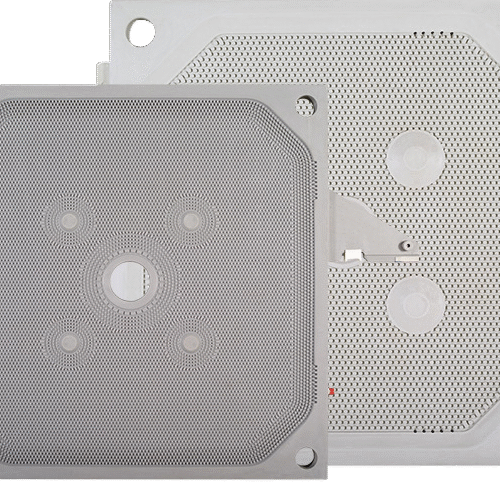
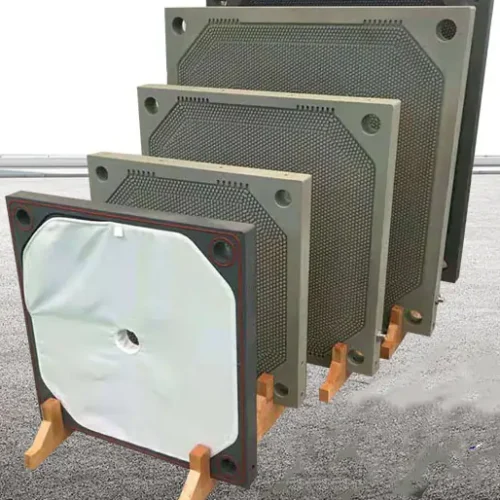
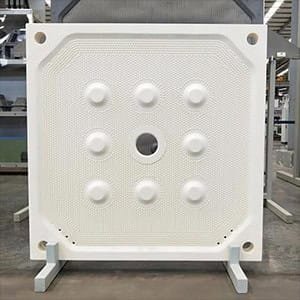
Quick answer: Filter plates are specified by size, type (recessed chamber, membrane or plate-and-frame), material and temperature rating, and cake thickness. Reinforced polypropylene handles up to about 90 °C, glass-reinforced PP up to about 120 °C. Plates are consumables: warped or cracked plates leak and cost far more in lost cycles than in replacement.
Plate types and what each is for
| Type | How it works | Cake moisture | Best for |
|---|---|---|---|
| Recessed chamber plate | Two recessed faces form a chamber; cake fills it and is squeezed only by feed pressure | 40–55% | The general-purpose plate; most industrial sludge |
| Membrane (diaphragm) plate | A flexible diaphragm inflates after filling and squeezes the cake at 1.5–2.0 MPa | 10–15 percentage points drier than chamber | Where disposal is charged by weight, or cake must be landfill-ready |
| Plate-and-frame | Alternating solid plates and open frames; chamber depth set by frame thickness | Varies with frame depth | Polishing duty, thin cakes, frequent cloth changes, food and pharma |
Membrane and chamber plates are often mixed in one press: membranes on every second position gives much of the squeeze benefit at lower cost. If you are unsure which applies, the difference is explained in detail in recessed plate vs membrane plate.
Specification
| Parameter | Typical range | Notes |
|---|---|---|
| Plate size | 320–2000 mm square | 630, 800, 870, 1000, 1250 and 1500 mm are the common sizes |
| Chamber depth | 25–50 mm typical | Deeper chambers hold more cake per cycle but take longer to fill and dry |
| Material | Reinforced PP to ~90 °C; glass-reinforced PP to ~120 °C | Cast iron and rubber-lined plates for special duty |
| Feed arrangement | Centre feed or corner feed | Must match the press; not interchangeable |
| Filtrate discharge | Open or closed discharge | Closed discharge where filtrate must be contained or is volatile |
| Design pressure | 0.6–1.0 MPa standard; up to 1.6 MPa high-pressure | Membrane squeeze rated separately at 1.5–2.0 MPa |
Frequently asked questions
How many filter plates do I need?
Work from cake volume per cycle. Divide the volume of cake you must produce per cycle by the volume of one chamber, then round up and add one or two spare positions. Chamber volume comes from plate size and chamber depth. The arithmetic with a worked example is in our guide to calculating the number of filter press plates.
What causes filter plates to warp or crack?
The four common causes are feeding above the plate design pressure, uneven closing force from a worn hydraulic system, feeding hot slurry above the plate temperature rating, and starting a cycle with cake residue left between plates. Warped plates no longer seal, so they leak at the edges and the leak worsens every cycle. Check plate flatness whenever edge leakage starts.
Can I mix membrane and chamber plates in one press?
Yes, and it is common practice. Alternating membrane and chamber plates gives most of the squeeze benefit at a lower cost than a full membrane set. The press must have the squeeze medium supply and the control sequence for it, so confirm the press specification before ordering membrane plates for an existing machine.
What temperature can polypropylene filter plates handle?
Standard reinforced polypropylene plates are rated to about 90 °C. Glass-reinforced polypropylene raises this to about 120 °C. Above that, plates in other materials are required. Running plates above their rating is a frequent cause of permanent deformation, and the damage is not always visible until the press starts leaking.
How do I order replacement plates for an existing press?
Send the plate size, plate type, chamber depth, feed arrangement (centre or corner), filtrate discharge type (open or closed), and the handle or hanging arrangement. A photograph of an existing plate with a tape measure in frame, plus one of the press itself, usually covers everything. Plates are made to the press, so the brand of the press does not matter.
What is the difference between open and closed filtrate discharge?
With open discharge each plate drains into a common trough where you can see it, which makes it easy to spot a torn cloth on a single plate. With closed discharge the filtrate is piped away inside the plate pack, which is required when the filtrate is volatile, hazardous, hot, or must be kept clean. Closed discharge costs more and makes leak diagnosis harder.
How long do filter plates last?
Plates are consumables but far longer-lived than cloth. Service life depends on pressure cycling, temperature and how the press is operated. Presses run within their design pressure and temperature, and cleaned properly between cycles, keep plates for years; presses regularly overfed or run hot damage plates in months.
Do you supply plates for presses made by other manufacturers?
Yes. Plates are made to the dimensions of the press, not to a brand. Supply the plate size, chamber depth, feed and discharge arrangement, and hanging detail — or send a sample plate — and matching plates can be produced, including for legacy and discontinued presses.
What to send with your enquiry
- Plate size and chamber depth
- Plate type: recessed chamber, membrane, or plate-and-frame
- Feed arrangement (centre or corner) and filtrate discharge (open or closed)
- Operating pressure and slurry temperature
- Quantity, and whether you also need matching filter cloth
A photograph of one existing plate laid flat with a tape measure in frame answers most of these at once.
Related
- Recessed plate vs membrane plate
- How to calculate the number of filter press plates
- Filter press cloth — cloth is made to match the plate
- Membrane filter press and chamber filter press
- Industrial wastewater treatment equipment and complete systems
Send your plate dimensions and operating conditions and we will quote matching plates: request a filter plate quotation.