
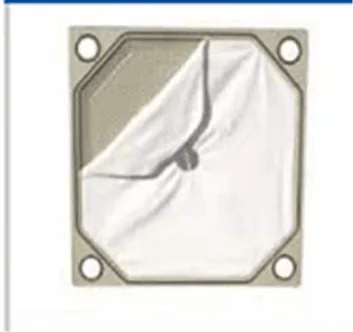
Quick answer: Filter press cloth is woven from polypropylene, polyester or polyamide and cut to your plate size. Typical ratings run 5–100 micron at 15–150 l/dm²/min air permeability depending on duty. Polypropylene covers most acid service; polyamide is specified where abrasion dominates.
| Application | Typical micron rating | Typical air permeability |
|---|---|---|
| Mining tailings dewatering | 40–100 micron | 80–150 l/dm²/min |
| Municipal wastewater sludge | 20–40 micron | 40–90 l/dm²/min |
| Chemical / pigment slurry | 5–20 micron | 15–40 l/dm²/min |
| Ceramic slip dewatering | 10–30 micron | 20–50 l/dm²/min |
| Food and beverage waste | 30–60 micron | 50–100 l/dm²/min |
| Cloth material | Typical chemical duty | Where it fits |
|---|---|---|
| Polypropylene (PP) | Good acid resistance, moderate alkali | Most economical, general-purpose duty |
| Polyamide (PA / nylon) | Good alkali resistance, moderate acid | Higher abrasion resistance for mineral duty |
| Polyester (PET) | Good general chemical resistance | Dimensional stability under repeated cycles |
| Yarn construction | Cake release | Filtrate clarity | Blinding resistance |
|---|---|---|---|
| Monofilament | Best | Lowest | Best |
| Multifilament | Average | Average | Average |
| Staple / spun | Poorest | Best | Lower |
All figures above are typical operating ranges for the cloth we weave and sew. Exact specifications are fixed against your slurry analysis and plate drawing, and are confirmed in the quotation — we do not publish fixed model specifications.
Filter Press Cloth | High-Performance Filtration Fabrics for Chamber & Membrane Filter Press
- Material Choices: Top-grade polyester, polypropylene, and nylon fabrics for all filtration conditions.
- Precision Weaving: Uniform pore size and strength, ensuring stable filtration, high flow, and long service life.
- Chemical & Thermal Resistance: Withstands acids, alkalis, solvents and high temperature media.
- Custom Fit: Cut and sewn to match any filter press plate size, shape, and feed hole design.
- Easy Cake Release: Advanced surface finishing for smooth cake discharge, reducing labor and maintenance time.
- Leak-Proof Edges: Options for welded or stitched edges to prevent bypass and leakage.
- Fast Installation & Replacement: Quick-change design, low downtime, and simple cleaning.
- Certified high-performance media, compliant with international standards.
- Wide range of micron ratings and weave patterns for every application.
- Fits all filter press models: chamber, membrane, plate-and-frame.
- Technical support for fabric selection, installation and troubleshooting.
- Fast global delivery, and responsive after-sales service.
Get a Quote Now
See also: Barrel neck vs latex edge vs drape-over filter cloth — which fixing method fits your plates?
Buyer FAQ
How do I choose the right filter cloth?
Match fibre, weave and micron rating to your particle size, chemistry and temperature; the goal is clear filtrate, easy cake release and long life.
Do you supply custom sizes?
Yes. Cloths are made to your plate type and dimensions, with barrel-neck, gasketed or open designs.
How do I choose filter cloth for my press?
Start from the slurry: particle size, pH, temperature and required filtrate clarity decide fibre and permeability; plate size and fixing method decide the pattern. A slurry sample and plate drawing are enough for a recommendation.
How often should filter cloth be replaced?
When filtrate turns cloudy, cycles lengthen despite washing, or cake stops releasing; that is typically 3–18 months depending on duty. Keeping a spare set on site avoids downtime.