
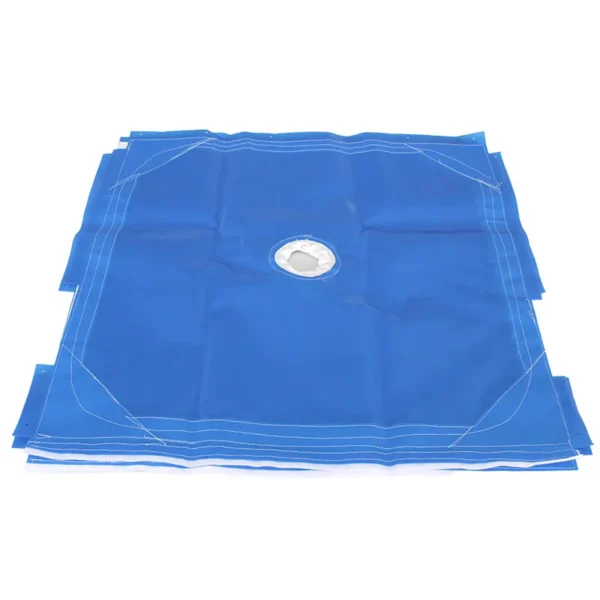
Quick answer: For mining concentrate and tailings dewatering, filter cloth is typically specified at 40–100 micron with 80–150 l/dm²/min air permeability. Polypropylene suits acidic circuits; polyamide is chosen where abrasion sets cloth life. Every cloth is cut and sewn to your plate drawing.
| Application | Typical micron rating | Typical air permeability |
|---|---|---|
| Mining tailings & concentrate dewatering | 40–100 micron | 80–150 l/dm²/min |
| Cloth material | Typical chemical duty | Where it fits |
|---|---|---|
| Polypropylene (PP) | Good acid resistance, moderate alkali | Most economical, general-purpose duty |
| Polyamide (PA / nylon) | Good alkali resistance, moderate acid | Higher abrasion resistance for mineral duty |
| Polyester (PET) | Good general chemical resistance | Dimensional stability under repeated cycles |
| Yarn construction | Cake release | Filtrate clarity | Blinding resistance |
|---|---|---|---|
| Monofilament | Best | Lowest | Best |
| Multifilament | Average | Average | Average |
| Staple / spun | Poorest | Best | Lower |
All figures above are typical operating ranges for the cloth we weave and sew. Exact specifications are fixed against your slurry analysis and plate drawing, and are confirmed in the quotation — we do not publish fixed model specifications.
Filter Cloth for Mining | Concentrate & Tailings Dewatering
- Corrosion & Chemical Resistance: Multi-layer weaving with selected polymers such as PP, PET, or customized blends ensures resilience to strong acids, alkalis, and hot process solutions. In phosphate rock dewatering, some clients have run up to 6,000 cycles without significant loss of permeability.
- Abrasion-Resistant Construction: Heavy-duty fiber reinforcement withstands the rigors of abrasive tailings and high-frequency cake discharge, ensuring reliable operation even during high solids loading.
- Easy Cake Release: Advanced surface finishing processes allow even sticky concentrate cakes (such as those from polymetallic ores or laterite nickel) to be discharged rapidly—reducing downtime and cleaning frequency.
- Customizable Fit: Whether using chamber presses, membrane presses, or belt filters, we tailor size, thickness, edge style, and welding/eyelet type to fit your equipment, guaranteeing a leak-free seal for efficient production.
- Low Moisture Residue: Real-world data from an African gold mine shows our cloths reducing tailings moisture by up to 7% compared to legacy fabrics.
- High Throughput: Engineered for rapid liquid drainage and minimal clogging, resulting in higher cycle rates and improved plant productivity.
- Durability under pressure: In a zinc plant in Northern Europe, a batch of our filter fabrics lasted 1 month in acid filtration tests without any edge wear or mesh collapse.
- Concentrate thickening and dehydration for copper, gold, lead-zinc, iron ore, and rare earth
- Tailings water recovery and dry stack filtration
- Chemical leach slurry separation and solvent extraction residue
- Dewatering of coal slurries and mineral fines
- Specialty filtration for lithium, cobalt, and battery metals
Case in Point:
In 2023, a nickel mine in Southeast Asia reported a 40% reduction in annual downtime and saved over $50,000 in labor and maintenance after adopting our custom membrane-press filter cloths.
Get a Quote
Related products & guides
Buyer FAQ
Do concentrate and tailings need different cloths?
Yes. Concentrate cloth is tight and release-oriented so valuable solids stay in the cake and filtrate is clear; tailings cloth is coarser and tougher for high-volume, abrasive, high-cycle duty.
What cloth life should I expect in a mine?
Typically 3–12 months depending on ore abrasiveness, cycles per day and washing. Reinforced edges and the right permeability matter more than fibre brand.