
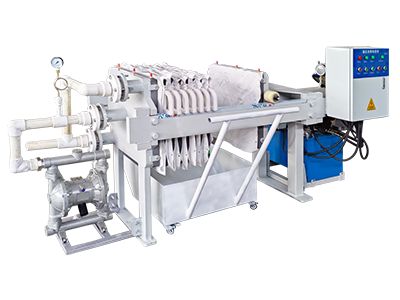
Quick answer: A wastewater filter press dewaters sludge from municipal and industrial treatment plants into a cake of roughly 60–75% moisture (drier with membrane squeeze) that can be landfilled, composted or incinerated, while returning clear filtrate to the plant. Small chamber presses with polypropylene plates suit plants producing a few tonnes of dry solids a day; larger or membrane presses are chosen as volume or disposal cost rises.
Wastewater Filter Press – Efficient Dewatering Solution for Industrial and Municipal Sludge
- High Dewatering Efficiency: Optimized plate design speeds up cake formation and achieves lower residual moisture, making sludge reduction easier.
- Automated Control: Standard PLC automation system enables automatic feeding, compression, plate shifting, cake discharge, and filter cloth washing, simplifying operation and saving labor.
- Durable Construction: All wetted parts are made of high-strength polypropylene or stainless steel. The main frame features anti-corrosion coating to withstand harsh environments.
- Energy-Saving & Eco-Friendly: Efficient hydraulic system and optimized pipeline layout minimize energy consumption and noise, supporting your sustainability goals.
- Wide Application Range: Suitable for industrial wastewater, municipal sludge, chemical slurry, and food and pharmaceutical waste.
- Plate Size: 630/870/1000/1250/1500mm (customizable)
- Filtration Pressure: 0.6–2.0MPa
- Control Mode: Manual / Hydraulic / Fully Automated PLC
- Plate Material: Polypropylene / Stainless Steel
- Capacity: Customized as required
- Adopting a wastewater filter press significantly reduces sludge volume, enhances dewatering efficiency, and cuts transportation and landfill costs.
- It is an essential solution for enterprises aiming for green production and environmental compliance.
- We provide professional, customized solutions for various wastewater types and treatment needs.
Get a Quote
See also: Small filter press for small plants — sizes, capacity and cost.
Buyer FAQ
How does a filter press reduce sludge disposal cost?
By dewatering sludge to a dry cake it sharply cuts weight and volume, so you haul and dispose of far less material.
Can it handle municipal and industrial sludge?
Yes. With the right cloth and optional membrane plates it handles both, including polymer-conditioned biosolids.
How do I size a wastewater filter press?
Size on kilograms of dry solids per day and cycles per day, not on wastewater flow. Cake volume per cycle equals the chamber volume, so plate size and count follow once daily dry solids and cycle time are known.
Does the sludge need conditioning?
Usually yes. Biological and hydroxide sludges are conditioned with polymer or lime/ferric so they filter in a reasonable cycle time and release from the cloth.