
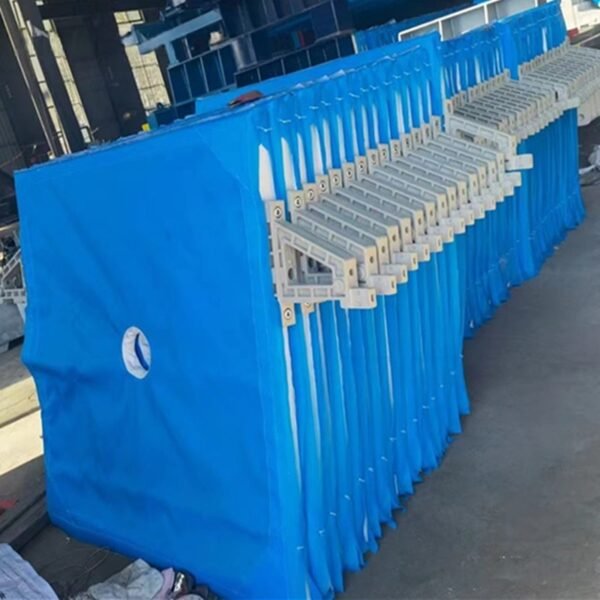
Quick answer: For chemical and fine-chemical slurries, filter cloth is typically specified at 5–20 micron with 15–40 l/dm²/min air permeability — the tightest range we weave. Polypropylene handles most acid duty; polyamide is preferred where alkali dominates.
| Application | Typical micron rating | Typical air permeability |
|---|---|---|
| Chemical / pigment slurry | 5–20 micron | 15–40 l/dm²/min |
| Cloth material | Typical chemical duty | Where it fits |
|---|---|---|
| Polypropylene (PP) | Good acid resistance, moderate alkali | Most economical, general-purpose duty |
| Polyamide (PA / nylon) | Good alkali resistance, moderate acid | Higher abrasion resistance for mineral duty |
| Polyester (PET) | Good general chemical resistance | Dimensional stability under repeated cycles |
| Yarn construction | Cake release | Filtrate clarity | Blinding resistance |
|---|---|---|---|
| Monofilament | Best | Lowest | Best |
| Multifilament | Average | Average | Average |
| Staple / spun | Poorest | Best | Lower |
All figures above are typical operating ranges for the cloth we weave and sew. Exact specifications are fixed against your slurry analysis and plate drawing, and are confirmed in the quotation — we do not publish fixed model specifications.
Filter Cloth for Chemical Industry | Fine Chemical Filtration
- Superior Chemical Resistance: The unique weaving structure ensures the cloth maintains dimensional stability and pore uniformity, even after hundreds of CIP (clean-in-place) cycles.
- Fine Particle Control: Multiple pore size options, from 1 micron up to 50 micron, guarantee high-efficiency capture of pigments, catalysts, and valuable intermediates.
- Mechanical Durability: Reinforced edges and anti-static treatment reduce blinding and cake adhesion, making for fast cake release and minimal manual intervention.
- Multi-process Adaptability: Compatible with plate and frame, chamber, and automatic membrane filter presses. FDA- and EU-compliant materials are available for pharmaceutical and food-contact applications.
- Permeability: 450–800 L/m²·h (water, 0.5 bar)
- Acid/alkali resistance: Long-term stable in pH 1–13
- Service life: ≥12 months under standard fine chemical process
Get a Quote
Related products & guides
Buyer FAQ
What makes a cloth suitable for several different products?
A polypropylene monofilament or multifilament with medium permeability and a calendered surface tolerates a wide pH range and releases many cake types cleanly, so one cloth can serve a press that changes products.
When should I switch to a dedicated cloth?
When a product needs finer particle retention, solvent resistance, temperatures above 90 °C, or when filtrate from one product must be exceptionally clear. A short test on that product’s slurry shows whether the versatile cloth is enough.