Mining & Mineral Processing

In mining and mineral processing, selecting the right solid–liquid separation equipment is critical. A specialized mineral processing filter press offers outstanding performance for tailings dewatering, slurry thickening, and concentrate recovery. With easy operation, high dewatering efficiency, and continuous run capability, our filter presses are widely used in non-metallic, metallic, and rare-earth mining industries.
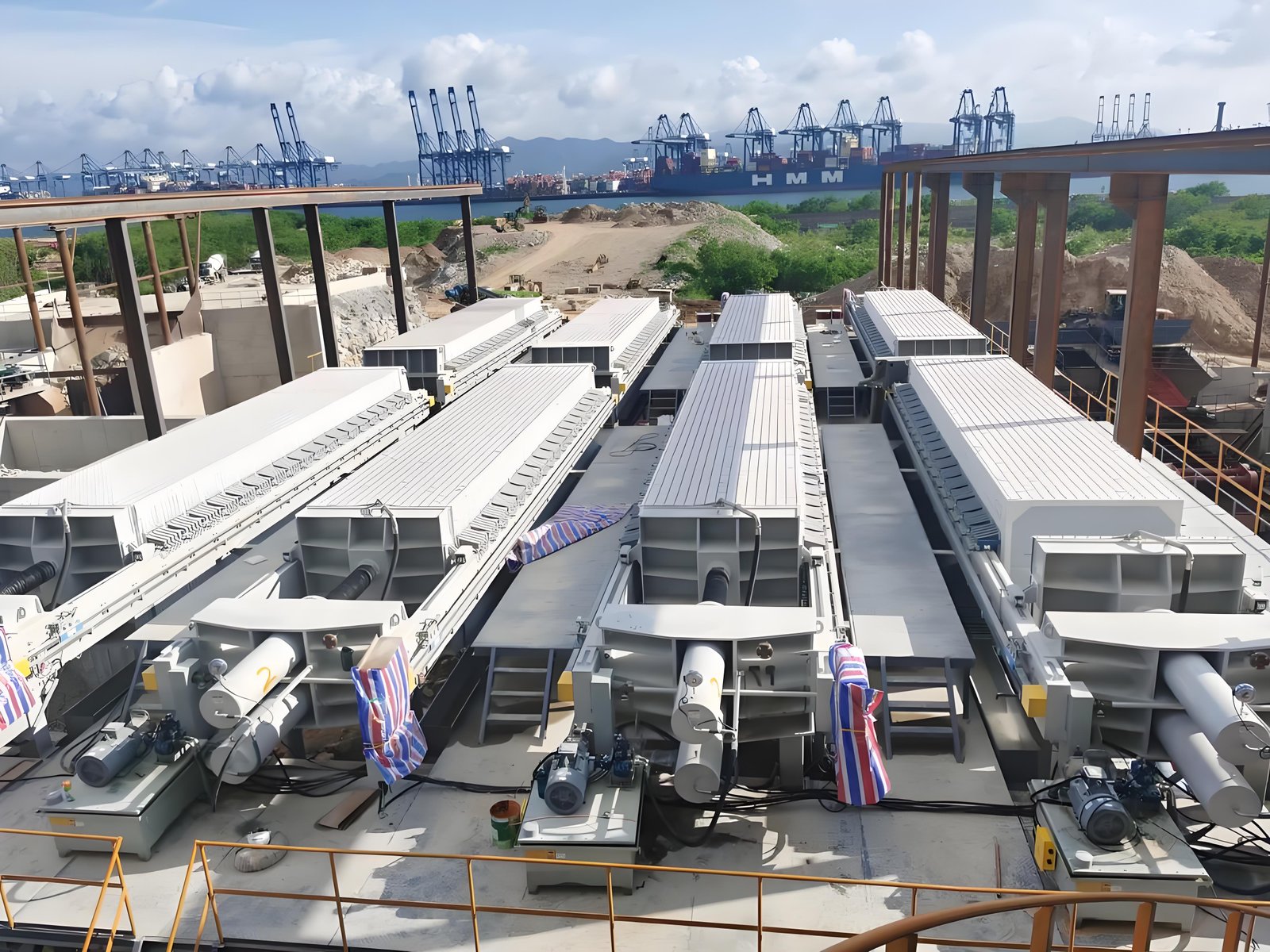
Filter Press in Operation

For example, gold, copper, lead-zinc, iron, and rare-earth ore beneficiation generate large volumes of slurry and tailings that are often corrosive and abrasive, leading to rapid equipment wear. Fine particle size and high clay content can clog filter cloth, and cake dryness may fall short of operational requirements. Choosing the wrong filter cloth grade only aggravates these issues and reduces filtration efficiency.

To overcome these challenges, we provide fully customized filter press systems for mineral processing. All wetted parts—filter plates, valves, and piping—are made from corrosion-resistant PP or stainless steel. We fit high-precision filter cloth to capture even the smallest particles and integrate automatic shaking and washing devices to prevent clogging. For ultra-low cake moisture, our high-pressure squeeze module can further reduce residual water. Automated discharge and material handling streamline large-scale tailings dewatering, boosting throughput while cutting labor costs.

By deploying our filter presses, you achieve much lower moisture in slurry and tailings, simplifying transport or dry stacking, saving space, and lowering tailings dam construction costs. The filtrate is virtually clean water, ready for reuse or further processing, helping you cut overall water consumption.

Contact us today to discuss the optimal filter press solution tailored to your mine’s specific requirements.

← Back to Industry Applications

What a filter press is doing in a mineral plant

Mining uses filtration at two quite different points in the flowsheet, and confusing them is the most common cause of a badly specified machine.

  • On the product side, concentrate is dewatered to a moisture that makes it saleable and shippable. The target is set by a contract or by cargo-safety rules, so the machine is chosen for consistency and control.
  • On the waste side, tailings are dewatered to reduce stored volume, recover process water and remove dam risk. The target is set by what stacks and hauls, and the machine is chosen for throughput and consumable life.

Detail on both: tailings and concentrate dewatering.

What makes mineral duty hard on equipment

Ore slurries are abrasive, dense and often warm, and they run continuously. The machine is rarely the weak point — the consumables are.

  • Cloth life is the dominant operating cost. Abrasion wears the weave; fines and scale blind it. See cloth for mining duty and what causes blinding.
  • Feed pump wear is predictable and should be budgeted, not treated as a failure. See slurry pumps for mineral processing.
  • Plate sealing faces suffer where coarse material is not removed upstream. Classification before filtration pays for itself.

Water recovery is often the real business case

In arid regions the filtrate returned to the mill can justify the installation on its own, independently of disposal savings. That calculation depends on your local water cost and your current losses to the tailings storage facility, so it is worth doing explicitly rather than assuming the press is a pure cost.

Ore-specific notes

Frequently asked questions

How do I size a press for a mineral plant?

From dry solids tonnage per day and the cycle time your material actually achieves — not from slurry flow. Cycle time has to be measured, which is why a filtration test comes before a quotation. See capacity calculation.

Recessed chamber or membrane plates?

Membrane squeeze earns its cost where the last few percent of moisture carry real money — a concentrate sales specification or a shipping limit. For tailings that are stacked rather than sold, recessed chamber plates are often enough.

Why does cloth life vary so much between sites?

Because it is driven by abrasiveness and fines content, not by machine hours. Two plants running identical presses on different ores can see very different replacement intervals. See cloth replacement intervals.

Send us a tailings or concentrate sample and we will test it before recommending anything — filtration testing and trials.