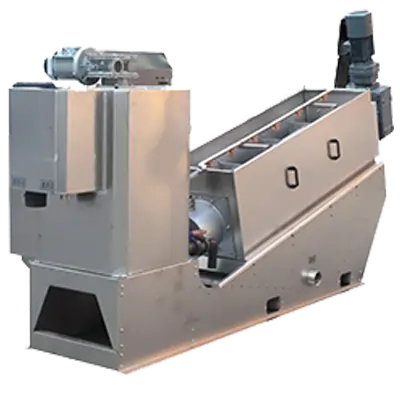
Quick answer: A multi-disc screw press dewaters sludge continuously at low speed, runs unattended around the clock, and handles the oily and greasy sludge that blinds a belt press. Its cake is wetter than a filter press cake. Choose it for continuous unattended operation; choose a filter press when cake dryness decides your disposal bill.
Specification
| Parameter | Typical | Notes |
|---|
| Operation | Continuous, not batch | Feeds and discharges without stopping — no cycle to supervise |
| Speed | Very low rotational speed | Low wear, low noise, low power draw |
| Self-cleaning | Moving and fixed rings shear against each other | This is why it tolerates oil and grease that blind a belt press |
| Wash water | Little or none | A belt press needs continuous spray water; this is often the deciding cost |
| Cake dryness | Wetter than a filter press cake | Adequate where disposal is charged by volume rather than weight |
| Feed solids | Works best on thickened sludge | Very dilute feed wastes capacity — thicken first |
| Polymer | Required — sludge must be conditioned | Floc quality drives performance more than machine size does |
| Attendance | Essentially unattended | Suits 24/7 municipal and food plants with small crews |
Screw press or filter press?
These two are often presented as rivals. In practice they answer different questions, and the honest comparison matters more than a sales pitch — picking the wrong one is expensive for years.
| Multi-disc screw press | Chamber / membrane filter press |
|---|
| Operation | Continuous | Batch cycle, 30 min to 4 h |
| Cake moisture | Wetter | 40–55% chamber; 10–15 points drier with membrane |
| Attendance | Essentially unattended | Cycle supervision, cloth changes, cake discharge |
| Oily / greasy sludge | Handles it — self-cleaning rings | Manageable, but oil blinds cloth faster |
| Wash water | Little or none | Periodic cloth washing |
| Footprint and power | Small, low power | Larger, plus hydraulic and feed pump power |
| Best when | Continuous flow, small crew, disposal charged by volume | Disposal charged by weight, hazardous cake, high solids recovery |
The deciding question is usually how your sludge disposal is charged. If the invoice is by weight, every point of moisture you remove is money, and a membrane filter press pays for itself. If it is by volume, or if the sludge goes to a digester or a farm, the screw press's lower running cost and unattended operation usually win.
Plants with both flows often run both: a screw press on the routine continuous sludge, a filter press on the fraction that must leave the site dry. That is a legitimate answer, not a hedge.
Frequently asked questions
Is a screw press better than a filter press?
Neither is better in general; they solve different problems. A screw press runs continuously and unattended and copes with oily sludge, but its cake is wetter. A filter press produces a much drier cake, which matters when disposal is charged by weight, but it runs in batches and needs supervision. Decide from how your sludge disposal is billed and how much attendance you can staff.
Why does a screw press handle oily sludge when a belt press cannot?
The moving and fixed rings shear past each other continuously, so the filtering surface cleans itself as it runs. A belt press relies on an open filter belt that oil and grease blind quickly, which is why belt presses need constant spray water and still lose capacity on greasy feed.
How much wash water does it need?
Very little, and many installations use none at all. This is often the real cost difference against a belt press, which needs continuous spray water plus the cost of treating that water again downstream.
Do I still need polymer?
Yes. The sludge must be conditioned so that it flocculates before it reaches the press. Floc quality affects performance more than machine size does — an undersized press with good conditioning usually outperforms an oversized press with poor conditioning.
Can it handle dilute sludge?
It works, but it wastes capacity. A screw press is most economical on thickened sludge, so where the feed is dilute a thickening stage ahead of it is normally cheaper than a larger press.
What maintenance does it need?
Very little by dewatering-equipment standards. Low speed means low wear; the rings and the screw are the long-term wear parts, and the drive needs routine lubrication. There is no filter cloth to replace and no belt to track and tension.
How do I size one?
Size on dry solids load per hour, not on volumetric flow, plus the sludge type and its conditioning behaviour. Send sludge type, dry solids concentration, daily volume, operating hours per day, and the polymer currently in use if any.
Can a screw press replace my filter press?
Only if wetter cake is acceptable. If your cake currently leaves site at 40 to 55 percent moisture and disposal is charged by weight, replacing a filter press with a screw press will raise your disposal bill. If disposal is by volume, or the sludge is digested or land-applied, replacement is often a genuine saving.
Related
Send your sludge type, dry solids concentration and daily volume and we will size the machine and say honestly whether a filter press would serve you better: request a sizing proposal.