

By Senjie Filter Press Engineering Team · Last updated: 2026-09-10
Quick answer: Filter press capacity is calculated by multiplying chamber volume per cycle by the number of chambers, converting that volume to dry solids weight using expected cake density and moisture content, then multiplying by achievable cycles per day. A press with 1000 mm plates and 60 chambers commonly processes roughly 1.5-3 tonnes of dry solids per cycle, depending on slurry type.
Key figures at a glance
- Capacity = chamber volume × number of chambers × cycles per day (as wet cake)
- Dry solids per cycle = cake volume × cake density × (1 − moisture)
- Typical chamber depth 25–40 mm; 1000 mm plate ≈ 0.03–0.04 m³ per chamber
- Typical cycles per day: 3–6 manual, 8–20 automatic
- Always confirm with a filtration test on the real slurry
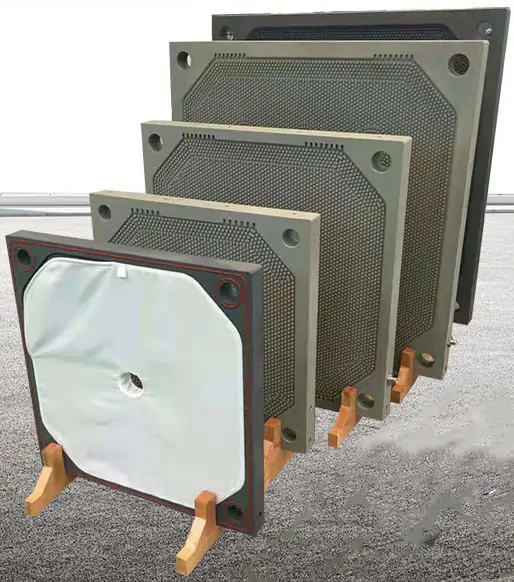
Getting capacity right means combining three separate numbers: how much slurry volume the plate pack physically holds, how much of that volume becomes dry cake versus filtrate, and how many times per day the cycle can repeat. The worked example below walks through each step using a 1000 mm plate press as a reference case, followed by the variables that most often throw off a first-pass estimate.
How do you calculate chamber volume for a filter press?
Chamber volume per plate is calculated as plate filtration area multiplied by chamber depth (the gap each recessed plate face forms, typically 25-32 mm before any membrane squeeze), and total chamber volume is that figure multiplied by the number of chambers in the pack. Senjie’s filter plates come in standard sizes of 320, 470, 630, 800, 1000, 1250, 1500, 1800, and 2000 mm, with plate thickness of 25-40 mm.
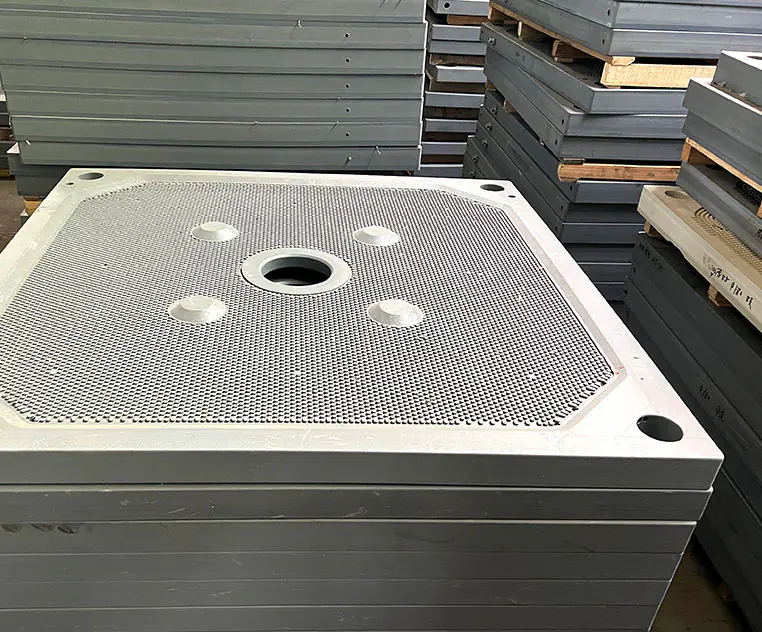
For a 1000 mm plate, filtration area per plate face is typically around 1.7-2.0 m² depending on the specific plate design and gasket area lost to sealing surfaces. With a 30 mm chamber depth, each chamber holds roughly 1.7 m² × 0.03 m = 0.051 m³ (about 51 liters) of slurry before pressing.
Worked example: sizing a 1000 mm plate press
Assume a press with 60 chambers at 1000 mm plate size, 30 mm chamber depth, and a slurry with 20% solids by weight and a slurry density of 1150 kg/m³.
- Total chamber volume: 60 chambers × 0.051 m³ = 3.06 m³ per full cycle.
- Total slurry mass fed per cycle: 3.06 m³ × 1150 kg/m³ = 3,519 kg of slurry.
- Dry solids mass per cycle: 3,519 kg × 20% = 704 kg of dry solids (before accounting for cake shrinkage and any solids lost to filtrate, typically a small fraction).
- Cycles per day: at 2 hours per cycle, roughly 10-11 usable cycles per 24 hours after allowing time for washing and changeovers.
- Daily dry solids capacity: 704 kg × 10 cycles ≈ 7 tonnes per day of dry solids.
This example is indicative; actual dry solids recovery depends on how completely the chambers fill each cycle and how much fine material passes through the filter cloth rather than reporting to cake.
What variables most affect the capacity estimate?
The variables with the biggest impact on a capacity estimate are feed solids concentration, achievable cycle time, and whether the press is a chamber or membrane design. Doubling feed solids concentration roughly doubles dry solids capacity for the same chamber volume and cycle time, while switching from a chamber press (1-4 hour cycles) to an automatic membrane press (30-90 minute cycles) on the same slurry can more than double cycles per day.
| Feed solids concentration: | pre-thickening slurry before the press (with a thickener or centrifuge) increases dry solids per cycle without adding plates. |
|---|---|
| Cycle time: | automation, correct feed pump sizing, and cloth condition all affect how many cycles fit in a working day. |
| Cake density after pressing: | denser cake (lower moisture) means less volume needed for the same dry solids output, effectively raising capacity. |
| Downtime for cloth washing and maintenance: | should be subtracted from theoretical daily cycles, typically 5-15% of available time. |
How does plate size selection affect throughput per unit footprint?
Larger plate sizes (1250-2000 mm) generally deliver more dry solids throughput per unit of floor footprint than smaller plates run in parallel, because a single large press needs one hydraulic system, one frame, and one control panel instead of duplicating them across multiple small presses. However, larger presses also require larger feed pumps capable of filling the greater chamber volume within an acceptable feeding time, so pump sizing must scale with plate size.
| Plate size | Approx. chamber volume per chamber (30 mm depth) | Typical use case |
|---|---|---|
| 630 mm | ≈0.02 m³ | Pilot plants, small industrial sites |
| 800 mm | ≈0.033 m³ | Small-to-mid municipal or industrial |
| 1000 mm | ≈0.051 m³ | Mid-size municipal, mining, chemical |
| 1250-1500 mm | ≈0.08-0.11 m³ | Large mining, bulk chemical processing |
| 1800-2000 mm | ≈0.14-0.18 m³ | Very large tailings and bulk industrial duty |
How should downtime and washing be factored into a capacity plan?
Downtime for cloth washing, plate inspection, and routine hydraulic maintenance should be subtracted from the theoretical number of cycles per day before quoting a daily capacity figure, typically reducing usable cycles by 5-15% versus the theoretical maximum. A plant that calculates capacity purely from cycle time without this allowance will consistently underperform its own paper estimate once real operating conditions — occasional cloth changes, brief hydraulic stops, shift changeovers — are accounted for.
A practical approach is to calculate theoretical daily cycles from cycle time alone, then apply a 10% downtime allowance as a starting planning figure, adjusting it upward or downward once actual operating data is available from a similar installation.
Why buy your press from Senjie?
Senjie is a China-based manufacturer of chamber, membrane, plate-and-frame, and fully automatic filter presses, founded in 2014 and exporting to 40+ countries across Southeast Asia, India, Africa, the Middle East, and Latin America, with filter area from 1 m² to 1000 m² per unit. Senjie’s engineering team runs capacity calculations against the buyer’s actual slurry data (solids %, density, target moisture) rather than generic assumptions before recommending plate count and size.
Review the full filter press range and chamber filter press line for standard plate configurations — indicative FOB China pricing is available on request.
Frequently Asked Questions
What information do I need to calculate filter press capacity?
You need chamber volume (from plate size, thickness, and count), the slurry’s solids concentration, the dry cake density after pressing, and the achievable cycle time. Without slurry-specific dewatering data the calculation gives an estimate only, not a guarantee.
How many cycles per day can a filter press run?
Most industrial installations run 8-16 cycles per day per press, based on cycle times of 1-4 hours for chamber presses or 30-90 minutes for automatic membrane presses, allowing for plate washing and maintenance downtime.
Does adding more plates increase capacity proportionally?
Roughly yes, since total chamber volume scales with plate count for a given plate size, but very long plate packs increase feeding time because more volume must be pumped per cycle, which can reduce cycles per day and partly offset the capacity gain.
How accurate is a capacity calculation without a lab test?
A calculation based on typical dry solids density and moisture assumptions is useful for first-pass sizing but can be off by 20-30% versus actual performance. A bench or pilot dewatering test on the actual slurry is recommended before finalizing plate count for a large installation.
Ready to spec the right press or component for your application? Contact Senjie’s engineering team for a free sizing recommendation and an indicative quotation.