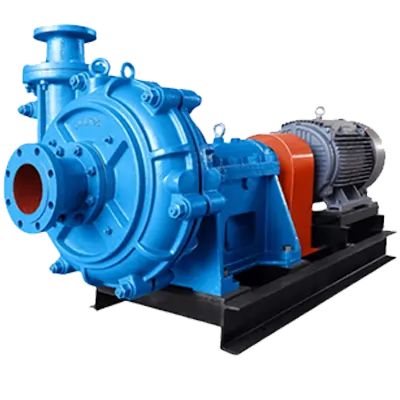
Quick answer: A centrifugal slurry pump moves large volumes of abrasive high-solids slurry cheaply, with heavy wear-resistant wet ends and replaceable liners. Flow falls as back pressure rises, so it fills a filter press quickly but cannot finish the high-pressure squeeze — that is normal, and the usual answer is a second pump for the finish.
Specification
| Parameter | Typical | Notes |
|---|
| Principle | Centrifugal impeller in a heavy wear-resistant casing | Flow falls as discharge pressure rises |
| Solids | High — the highest volumetric solids of the four pump types | Large passages tolerate coarse particles |
| Abrasion | Very high resistance | Built for mineral, stone, sand and tailings duty |
| Wet end materials | High-chrome alloy, or rubber-lined | High-chrome for coarse sharp particles; rubber for fine abrasive slurry |
| Wear parts | Replaceable liners, impeller and throatbush | Designed to be rebuilt rather than replaced |
| Sealing | Gland packing, expeller or mechanical seal | Packing needs flush water; expeller avoids dilution |
| Pressure at the press | Falls sharply as chambers fill | Best used as a filling pump, not a squeezing pump |
Where it fits in a filter press circuit
The first part of a press cycle moves the most volume at the least pressure, and the last part moves almost nothing at the highest pressure. A centrifugal slurry pump is excellent at the first and useless at the second. Used alone it fills the chambers fast and then trails off, leaving a wet, unevenly packed cake.
The standard arrangement is therefore two pumps: the slurry pump fills, then a ceramic piston or multi-stage progressing cavity pump takes the pressure up to the finish. Where a single pump must do both, expect either a slow fill or a poor finish.
Rubber-lined or high-chrome is decided by particle shape as much as hardness: fine rounded abrasive suits rubber, coarse sharp particles cut rubber and suit high-chrome.
Which feed pump for a filter press?
The feed pump decides whether a filter press cycles cleanly or fights you every batch. Four types cover almost all duty, and the choice follows the slurry, not the press.
| Pump | Solids | Abrasion | Max feed pressure | Picks it when |
|---|
| Air-operated diaphragm | Low to medium | Medium | Limited by air supply, typically to ~0.7 MPa | Simple, self-priming, can run dry and stall against a closed press without damage |
| Progressing cavity (screw) | Medium to high | Medium | High, rises with number of stages | Viscous, shear-sensitive or polymer-conditioned sludge; smooth, pulsation-free flow |
| Centrifugal slurry | High | Very high | Lower — flow falls sharply as the press fills | High-volume abrasive slurry; often used as a first-stage filling pump |
| Ceramic piston | High | Very high | Highest — suits 1.6 MPa high-pressure and membrane presses | The final squeeze stage, and abrasive duty that destroys other pump wet ends |
A common and economical arrangement pairs two pumps: a centrifugal slurry pump fills the chambers quickly at low pressure, then a piston or progressing cavity pump takes over for the high-pressure finish. One pump sized for both ends of the cycle is usually oversized for the start and underpowered for the finish.
Frequently asked questions
Why does my slurry pump lose flow as the filter press fills?
That is inherent to centrifugal pumps, not a fault. Flow falls as discharge pressure rises, and a filling press raises pressure steadily. Use the slurry pump to fill and a positive displacement pump — ceramic piston or multi-stage progressing cavity — for the high-pressure finish.
Rubber-lined or high-chrome: which should I choose?
Particle shape decides it. Fine, rounded abrasive particles suit rubber liners, which absorb impact and wear slowly. Coarse, sharp or angular particles cut rubber and suit high-chrome alloy. Very high temperature or aggressive chemistry also rules out rubber.
What wears out first and how do I plan for it?
Normally the impeller and throatbush, then the liners. Slurry pumps are designed to be rebuilt, so plan a wear part set as a stocked spare rather than treating wear as a failure. Track discharge pressure at constant speed — a steady fall means the clearances have opened up.
Can a slurry pump run dry?
No. Running dry destroys the seal quickly and can damage the wet end. Keep the suction flooded and fit a level switch on the sump.
Do I need gland flush water?
If the pump uses gland packing, yes — flush water keeps the packing cool and stops slurry entering. It does dilute the slurry slightly. An expeller or mechanical seal avoids the dilution at higher cost and more maintenance.
What information do you need to size one?
Flow rate, slurry solids content and particle size distribution, particle hardness and shape, slurry density, pH and temperature, plus the discharge head required. Tell us whether it is filling a filter press and we will size the pair rather than one oversized pump.
Related
Send your slurry description, flow rate and required feed pressure and we will quote the pump with the press: request a pump quotation.