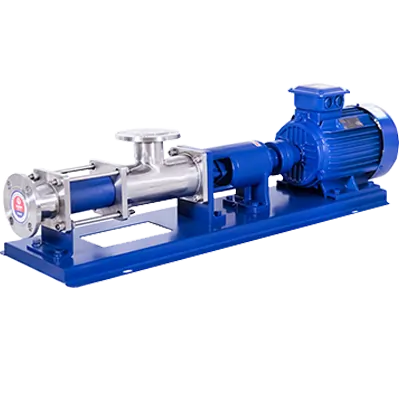
Quick answer: A progressing cavity pump moves a fixed volume per revolution with almost no pulsation and very low shear, which is why it is the standard choice for polymer-conditioned sludge and viscous feed. Pressure rises with the number of stages. Its one hard rule: it must never run dry, or the stator is destroyed in minutes.
Specification
| Parameter | Typical | Notes |
|---|
| Principle | Single helical rotor turning inside a twin-helix elastomer stator | Positive displacement; flow is proportional to speed |
| Flow control | Directly by speed — a VFD gives precise, repeatable feed | Well suited to automated press cycles |
| Pressure | Rises with stage count; multi-stage units reach high feed pressure | Roughly 0.6 MPa per stage as a rule of thumb |
| Solids | Medium to high, including soft and fibrous material | Tolerates material that jams ball check valves |
| Shear | Very low | Does not break polymer floc — the main reason it is chosen for conditioned sludge |
| Stator materials | NBR, EPDM, Viton, natural rubber | Selected against chemistry and temperature |
| Dry running | Not permitted | Fit dry-run protection; a few minutes dry ruins the stator |
Why it suits conditioned sludge
Sludge dosed with polymer forms a fragile floc. Pump it through a high-shear device and the floc breaks, the sludge de-waters far worse, and polymer consumption climbs to compensate. A progressing cavity pump moves the sludge in sealed cavities with almost no shear, so the floc arrives at the press intact. On municipal and food-industry sludge this alone can change cake moisture by several points.
The pulsation-free flow also matters: a steady feed builds cake evenly across the chamber, while a pulsing feed tends to pack unevenly and leaves wet pockets.
Which feed pump for a filter press?
The feed pump decides whether a filter press cycles cleanly or fights you every batch. Four types cover almost all duty, and the choice follows the slurry, not the press.
| Pump | Solids | Abrasion | Max feed pressure | Picks it when |
|---|
| Air-operated diaphragm | Low to medium | Medium | Limited by air supply, typically to ~0.7 MPa | Simple, self-priming, can run dry and stall against a closed press without damage |
| Progressing cavity (screw) | Medium to high | Medium | High, rises with number of stages | Viscous, shear-sensitive or polymer-conditioned sludge; smooth, pulsation-free flow |
| Centrifugal slurry | High | Very high | Lower — flow falls sharply as the press fills | High-volume abrasive slurry; often used as a first-stage filling pump |
| Ceramic piston | High | Very high | Highest — suits 1.6 MPa high-pressure and membrane presses | The final squeeze stage, and abrasive duty that destroys other pump wet ends |
A common and economical arrangement pairs two pumps: a centrifugal slurry pump fills the chambers quickly at low pressure, then a piston or progressing cavity pump takes over for the high-pressure finish. One pump sized for both ends of the cycle is usually oversized for the start and underpowered for the finish.
Frequently asked questions
Why must a progressing cavity pump never run dry?
The rotor turns inside an elastomer stator and relies on the pumped liquid for lubrication and cooling. Run dry and friction destroys the stator within minutes, sometimes seconds on a hot day. Always fit dry-run protection — a level switch in the sump, a pressure or temperature sensor at the stator, or a flow switch.
How do I increase the feed pressure?
Add stages. Each additional stage raises the achievable differential pressure, roughly 0.6 MPa per stage as a working rule. Increasing speed raises flow, not pressure, and running a pump faster than rated shortens stator life sharply.
What is the difference between a progressing cavity pump and a diaphragm pump for press feed?
A progressing cavity pump gives smooth, precisely controllable, low-shear flow and reaches higher pressure, but it cannot run dry and cannot stall against a closed press without protection. A diaphragm pump is simpler and stall-tolerant but pulses, consumes compressed air and has a lower pressure ceiling.
How long does a stator last?
It depends on abrasion, chemistry, temperature and how often the pump runs near its pressure limit. Abrasive slurry and frequent near-stall operation shorten life considerably. A worn stator shows up as falling flow at the same speed, so track flow against speed rather than waiting for failure.
Can it handle abrasive slurry?
It can, but abrasion is the main wear mechanism on the stator and rotor. For heavily abrasive duty such as mineral concentrate, a slurry pump or ceramic piston pump lasts longer. For sludge, food and chemical duty the progressing cavity pump is usually the better fit.
Which stator material should I choose?
NBR for general sludge and oils, EPDM for acids, alkalis and hot water, Viton for aggressive chemistry and higher temperature, natural rubber for abrasion. Send the slurry chemistry, temperature and solids content and the material is selected with the quotation.
Related
Send your slurry description, flow rate and required feed pressure and we will quote the pump with the press: request a pump quotation.