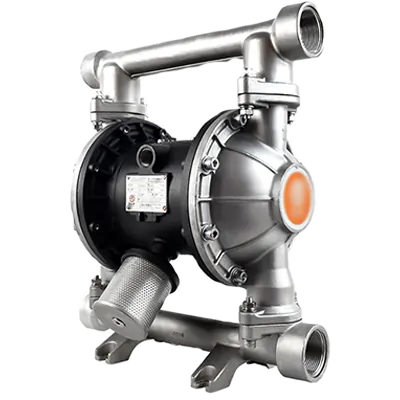
Quick answer: An air-operated diaphragm pump (AODD) runs on compressed air, self-primes, handles solids and can stall against a closed filter press without damage. That stall tolerance is why it is the most forgiving filter press feed pump. The trade-off is air consumption and a feed pressure ceiling set by your air supply.
Specification
| Parameter | Typical | Notes |
|---|
| Drive | Compressed air, typically 0.4–0.7 MPa | No electric motor at the pump — suits wet, dusty or hazardous areas |
| Feed pressure | Roughly 1:1 with air pressure, so ~0.7 MPa maximum | Adequate for standard chamber presses; not for 1.6 MPa high-pressure duty |
| Solids handling | Low to medium solids, soft and semi-soft particles | Ball check valves will hang on stringy or fibrous material |
| Wetted materials | PP, PVDF, aluminium, cast iron, stainless steel | Chosen against slurry chemistry |
| Diaphragm materials | Santoprene, PTFE, NBR, EPDM | PTFE for aggressive chemistry; Santoprene for general abrasion and flex life |
| Self-priming | Yes, including dry start | Can be mounted above the sump |
Why it suits filter press feed
As a filter press fills, back pressure climbs and flow must fall. A centrifugal pump fights this and overheats; a positive displacement pump without protection builds pressure until something gives. An AODD simply slows down and finally stalls, holding pressure without damage, and restarts on its own when the cycle opens. That behaviour removes the need for a bypass loop or complex pressure control on smaller presses.
The cost is air. AODDs are inefficient in energy terms, so on large presses running continuously the compressor bill can outweigh their simplicity. Above roughly medium duty, a progressing cavity or piston pump is normally cheaper to run.
Which feed pump for a filter press?
The feed pump decides whether a filter press cycles cleanly or fights you every batch. Four types cover almost all duty, and the choice follows the slurry, not the press.
| Pump | Solids | Abrasion | Max feed pressure | Picks it when |
|---|
| Air-operated diaphragm | Low to medium | Medium | Limited by air supply, typically to ~0.7 MPa | Simple, self-priming, can run dry and stall against a closed press without damage |
| Progressing cavity (screw) | Medium to high | Medium | High, rises with number of stages | Viscous, shear-sensitive or polymer-conditioned sludge; smooth, pulsation-free flow |
| Centrifugal slurry | High | Very high | Lower — flow falls sharply as the press fills | High-volume abrasive slurry; often used as a first-stage filling pump |
| Ceramic piston | High | Very high | Highest — suits 1.6 MPa high-pressure and membrane presses | The final squeeze stage, and abrasive duty that destroys other pump wet ends |
A common and economical arrangement pairs two pumps: a centrifugal slurry pump fills the chambers quickly at low pressure, then a piston or progressing cavity pump takes over for the high-pressure finish. One pump sized for both ends of the cycle is usually oversized for the start and underpowered for the finish.
Frequently asked questions
Can an air-operated diaphragm pump run dry?
Yes. AODD pumps are designed to run dry and to self-prime without damage, which is one of their main advantages over centrifugal and progressing cavity pumps. Running dry for long periods still wears the diaphragms, so it should not be the normal operating state.
What happens when the filter press is full?
The pump stalls. As back pressure rises to match the supplied air pressure the pump slows and then stops, holding pressure without overheating or building damaging pressure. When the press opens the pump restarts by itself. This is why AODD pumps need no relief loop on smaller presses.
Why is my diaphragm pump losing flow or pulsing badly?
The common causes are insufficient air supply volume, a worn or torn diaphragm, ball check valves held open by debris, a blocked air valve or muffler, and air leaks on the suction side. Check air supply first, then the muffler, then the check balls.
Which diaphragm material should I choose?
Santoprene for general industrial slurry and the longest flex life, PTFE for aggressive chemistry and solvents, NBR for oils, EPDM for acids and alkalis. Tell us the slurry chemistry, temperature and solids and the material is selected with the quotation.
How much air does it consume?
Consumption depends on pump size, stroke rate and discharge pressure. Size the compressor for peak duty, not average, or the pump will starve at exactly the moment the press needs pressure. Send your flow and pressure requirement and we will quote the air demand with the pump.
Can it pump abrasive slurry?
It can, but abrasion wears diaphragms and check balls faster than it wears a piston pump wet end. For continuously abrasive duty such as mineral concentrate or stone slurry, a ceramic piston or slurry pump is the better long-term choice.
Related
Send your slurry description, flow rate and required feed pressure and we will quote the pump with the press: request a pump quotation.