
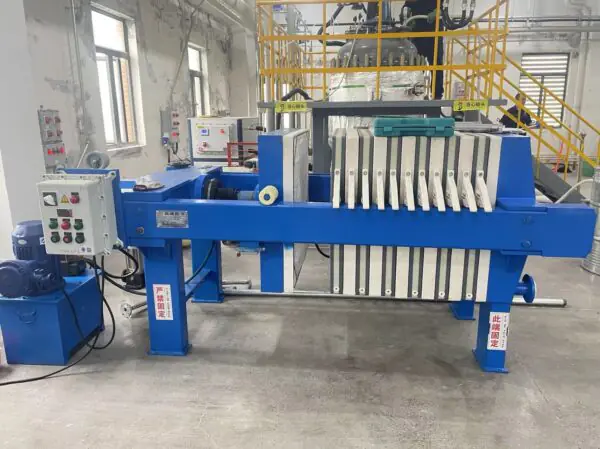
Quick answer: A plate-and-frame filter press alternates solid plates and hollow frames, forming cakes whose thickness equals the frame; it is chosen when the cake must be removed intact, cakes are thin, or cloths are changed often — typical in food, pharmaceutical, edible-oil and small-batch chemical work. For continuous high-volume sludge duty a chamber press is the faster choice.
Plate and Frame Filter Press: Efficient Industrial Filtration for Multiple Applications
With its straightforward design—alternating plates and frames made from corrosion-resistant materials—this filter press adapts effortlessly to changing capacity needs. Maintenance is simple: plates are easy to swap, gaskets quick to replace, and cleaning can be completed with minimal downtime. Operators benefit from the press’s flexibility, which makes it equally suitable for pilot batches and full-scale production.
- Structure: Robust frames built from premium carbon steel or 304/316 stainless steel, engineered for long service even in demanding environments.
- Filter Plates: Choose between high-density polypropylene and stainless steel plates; both maintain integrity at high pressures.
- Sealing Gaskets: Reliable EPDM or silicone rubber gaskets, effective even as temperatures near 100°C.
- Operating Pressure: Capable of up to 1.6 MPa, allowing rapid cycles and thorough separation of fine particles.
- Modular Setup: Flexible configuration—expand chamber volume or plate quantity as required by your workflow.
- Maintenance: Open layout for fast inspection, straightforward servicing, and efficient cleaning.
- Adaptable system that can scale with your needs and simplify cleaning routines.
- Designed for industrial durability, with components that withstand both chemical attack and mechanical stress.
- Consistently delivers efficient filtration, helping keep downtime low and productivity high.
- Backed by responsive technical support, and a global network for rapid spare part delivery.
- Custom-engineered options for sector-specific requirements.
Get a Quote Now
Buyer FAQ
When is a plate-and-frame press the best choice?
For small batches, low budgets, frequent cloth changes or clarifying valuable liquids, where simplicity and low cost matter more than automation.
Is it suitable for food and pharmaceutical use?
Yes. With food-grade cloth and stainless components it suits juice, oil, syrup and fine-chemical clarification.
When is plate-and-frame better than a chamber press?
When the cake must be removed intact, cakes are thin, or cloths are changed often — typical in food, pharmaceutical and small-batch chemical work. For continuous high-volume sludge duty a chamber press is faster and easier to automate.
What cake thickness does a plate-and-frame press give?
Cake thickness equals the frame thickness, usually 20–40 mm; thinner cakes wash and dry more evenly, thicker ones give more volume per cycle.